
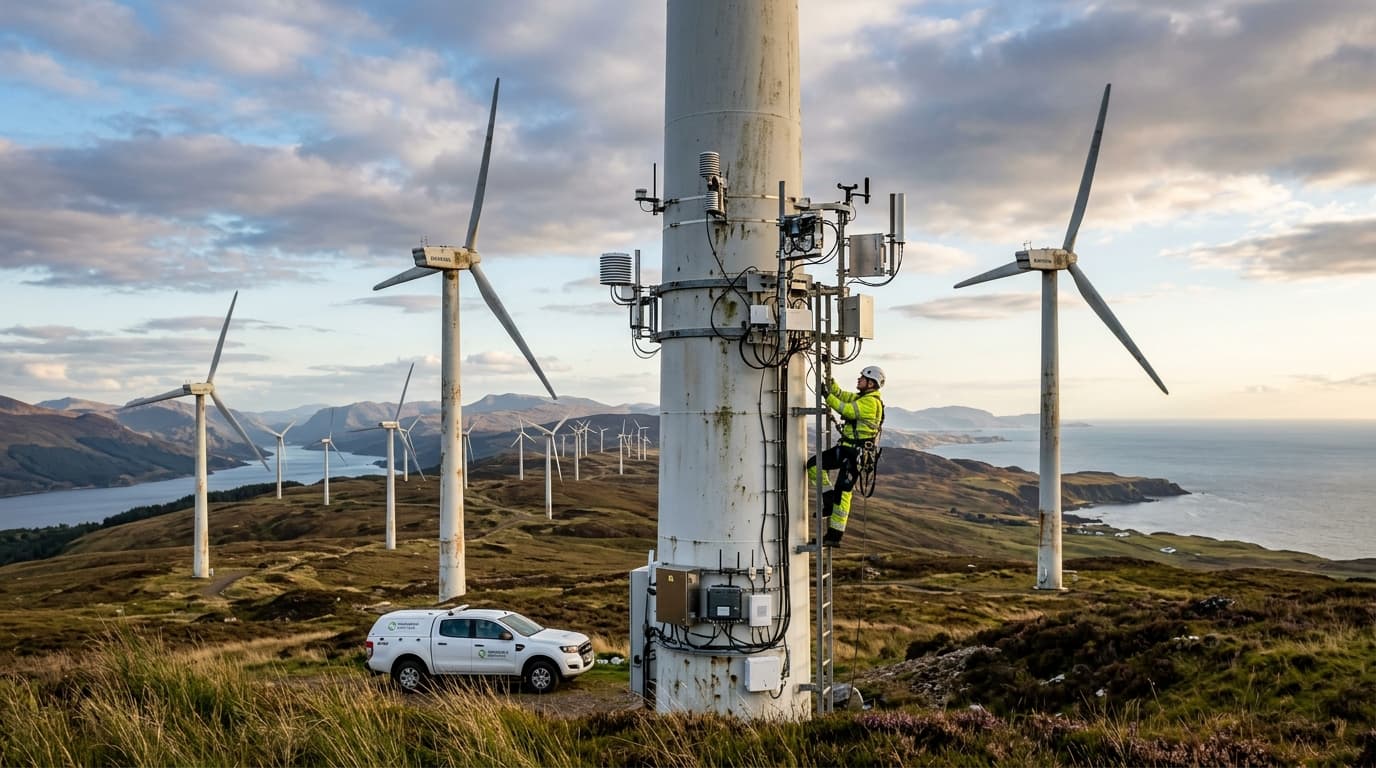
As early-generation wind turbines approach the end of their original design life, operators face critical strategic decisions. Many assets still operate reliably, yet increasing maintenance costs, aging components, and structural fatigue introduce uncertainty regarding long-term performance. Rather than relying solely on decommissioning or full repowering, life extension programs supported by retrofit monitoring provide a data-driven path to safely extend turbine operation.
Retrofit monitoring enables detailed insight into the structural, mechanical, and operational behavior of aging wind turbines. By equipping legacy assets with modern sensing and analytics technologies, operators can better understand remaining useful life, identify risk drivers, and optimize maintenance strategies.
This article explores how retrofit monitoring supports life extension strategies for aging wind turbines, and how data-driven assessment helps operators balance safety, performance, and economic value.
Why Life Extension Matters for Aging Wind Turbine Fleets
A significant portion of the global wind turbine fleet is reaching or exceeding its original 20 to 25 year design life. However, many of these assets remain structurally capable of continued operation, especially in moderate wind environments.
Life extension is increasingly important due to:
high costs associated with full repowering or decommissioning
regulatory and grid-connection constraints
ongoing revenue potential from existing assets
sustainability and resource reuse objectives
Instead of treating end-of-life strictly as a fixed threshold, operators are shifting toward condition-based lifetime evaluation. Retrofit monitoring plays a central role in enabling this transition.
What Is Retrofit Monitoring and How It Supports Asset Lifetime Management
Retrofit monitoring refers to the installation of additional instrumentation and digital monitoring systems on existing wind turbines that were originally deployed with limited sensing capabilities.
These retrofit solutions typically include:
structural load and strain measurement
vibration and drivetrain monitoring
environmental and operational data logging
health and performance analytics software
The objective is not simply to collect more data, but to generate meaningful insight into:
asset integrity
degradation trends
operational stress exposure
remaining useful life estimation
By integrating retrofit monitoring into lifetime management programs, operators can move from reactive maintenance toward proactive and evidence-based decision making.
Structural Health and Fatigue Assessment in Aging Turbines
Over decades of operation, wind turbines experience cyclic loading that contributes to fatigue accumulation across blades, towers, foundations, and drivetrain components. Traditional design assumptions often rely on generalized load cases rather than actual lifetime exposure.
Retrofit monitoring enables more accurate fatigue assessment through:
strain and load measurement under real operating conditions
identification of high-stress operating regimes
comparison of measured loads to historical design assumptions
detection of evolving structural anomalies
This information allows engineers to evaluate whether an asset has experienced:
higher-than-expected fatigue usage
relatively mild operational loading
or non-uniform stress distribution across components
Such insights are essential when determining whether continued operation remains structurally feasible.
Condition Monitoring and Performance Benchmarking for End-of-Life Assets
As turbines age, performance degradation and mechanical wear may increase gradually. Without monitoring, small issues may go undetected until they develop into costly failures.
Retrofit condition monitoring supports:
vibration-based drivetrain health analysis
gearbox and bearing wear detection
generator and shaft alignment assessment
aerodynamic or control-related performance deviations
In parallel, performance benchmarking allows operators to:
compare aging turbines against fleet averages
evaluate efficiency loss over time
identify turbines operating below expected output
Together, these insights support targeted maintenance investment rather than uniform replacement or shutdown.
Using Retrofit Monitoring Data for Predictive Maintenance and Risk Reduction
One of the most valuable outcomes of retrofit monitoring is the ability to transition from corrective maintenance to predictive maintenance.
Monitoring data supports:
anomaly detection
trend and degradation modeling
failure risk prioritization
smarter maintenance scheduling
Instead of responding to unexpected breakdowns, operators can:
plan interventions based on real risk exposure
extend component life where acceptable
prevent cascading failure scenarios
This approach improves safety while reducing both downtime and unexpected repair costs.
Retrofit-Based Upgrade Strategies for Extending Operational Lifetime
Life extension strategies often combine monitoring insights with targeted retrofit upgrades. These may include:
reinforcement or localized structural improvements
component replacements with higher reliability alternatives
control and pitch strategy optimization to reduce stress loading
software or operational strategy updates
The goal is to extend life without overinvesting in aging assets.
Monitoring data ensures that upgrades are implemented where they deliver the highest benefit and are technically justified by measured asset condition.
Economic and Operational Benefits of Life Extension Programs
When supported by retrofit monitoring, life extension programs can deliver significant value:
additional years of energy production
deferred capital expenditure on new installations
reduced risk through evidence-based asset assessment
improved return on investment over lifecycle
In many cases, targeted upgrades and data-driven management are more cost-effective than immediate repowering or decommissioning.
The Future Role of Retrofit Monitoring in Wind Turbine Lifecycle Management
As the global wind fleet continues to mature, lifecycle management will increasingly rely on accurate operational data rather than fixed design assumptions. Retrofit monitoring will play a central role in:
standardized lifetime assessment methodologies
improved structural reliability models
fleet-level risk prioritization
smarter investment and maintenance strategies
By integrating retrofit monitoring into long-term asset management, operators can extend turbine lifetimes in a safer, more predictable, and economically sustainable manner.