
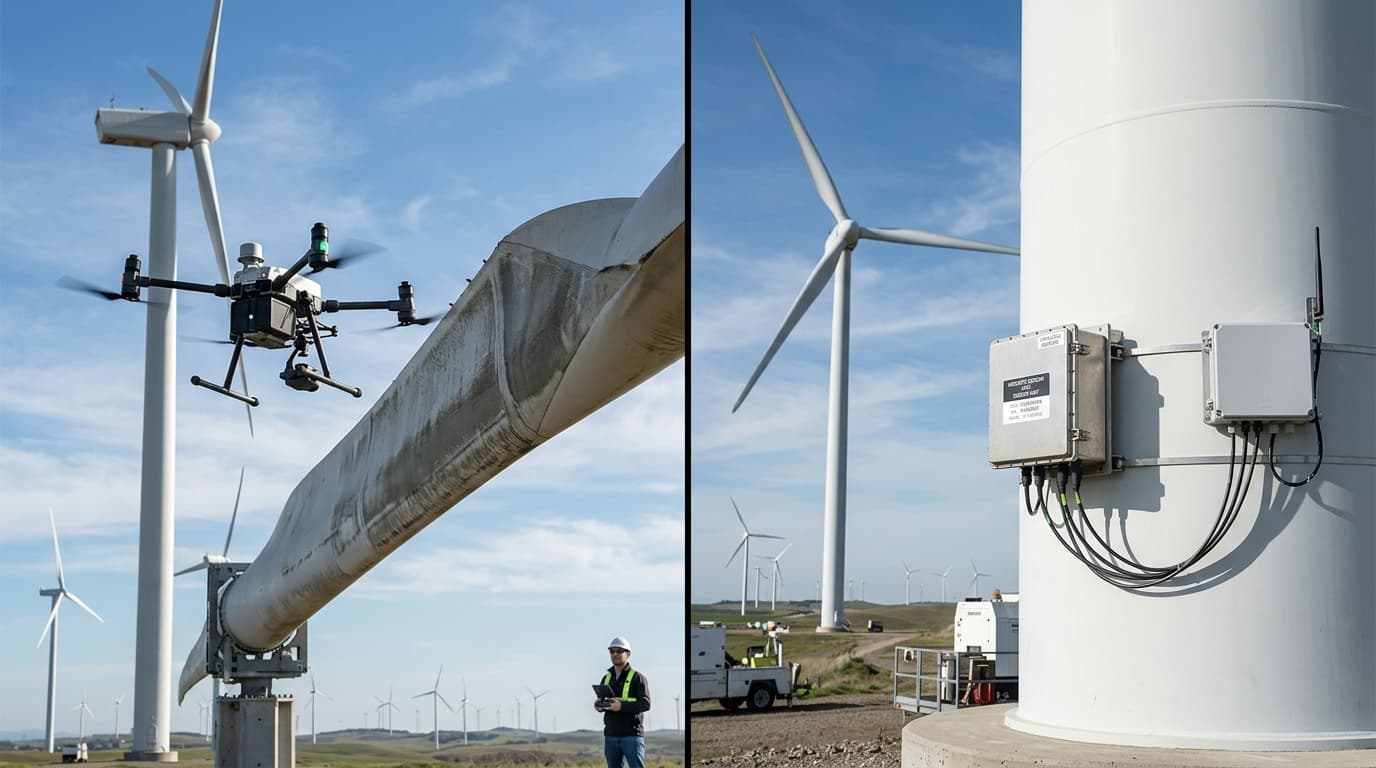
Most wind farms need both acoustic monitoring and drone inspection, but for different reasons. Drone inspection creates detailed visual evidence of blade condition at a defined moment. Continuous acoustic monitoring tracks changes between those inspections and can indicate when closer investigation is needed. The stronger strategy connects ongoing awareness with targeted visual or nondestructive confirmation.
Key takeaways
Drone inspection is strongest when operators need high-resolution visual documentation of accessible blade surfaces.
Continuous acoustic monitoring is strongest when teams need ongoing awareness of change between inspection campaigns.
Neither method should be treated as a complete physical diagnosis of every blade defect.
The most useful workflow is often: monitor continuously, prioritize intelligently, inspect visually, confirm where necessary, and track after repair.
What does drone blade inspection provide?
Drone blade inspection provides a point-in-time visual record of a wind turbine blade’s external condition. A drone can carry high-resolution cameras and, depending on the inspection system, other sensors such as thermal cameras or LiDAR. The resulting images help specialists identify, document, locate, and compare visible surface findings.
A 2025 peer-reviewed review of drone-based wind turbine blade inspection describes cameras as the most established sensor type, while also covering thermal imaging, LiDAR, ultrasonic methods, and acoustic-emission techniques. The review highlights the efficiency and safety advantages of drones compared with traditional access methods, while noting continuing challenges around environmental conditions, data quality, navigation, and automated interpretation (Heo and Na, 2025).
Drone inspection is particularly useful for:
documenting leading-edge erosion, coating damage, cracks, gaps, or other visible surface findings;
recording the location and apparent extent of a finding;
establishing a baseline for future comparison;
supporting repair scoping and post-repair visual checks;
reducing the need to place personnel at height during routine visual surveys.
Its main limitation is time coverage. The images show what was visible during the flight. If blade condition changes days or months later, the inspection record does not update itself. Image quality and coverage can also be affected by lighting, weather, viewing angle, surface contamination, and the capabilities of the sensor and analysis process.
What does continuous acoustic blade monitoring provide?
Continuous acoustic blade monitoring provides ongoing evidence about how blade-generated sound patterns change during operation. Windrover, a blade-monitoring product by Werover, uses a tower-mounted acoustic device and software analytics to identify and track signals associated with surface-level blade anomalies.
This approach is designed to address the visibility gap between scheduled inspections. Instead of waiting for the next campaign to learn whether conditions have changed, O&M teams can use monitoring trends and alerts to identify turbines that may require closer investigation. Werover describes Windrover as a tower-mounted system that operates independently of turbine SCADA and supports continuous blade-condition awareness during operation (Werover real-time blade monitoring).
Continuous acoustic monitoring is particularly useful for:
identifying changes between scheduled inspections;
tracking whether an acoustic anomaly appears stable or is evolving;
prioritizing turbines for drone, rope-access, or nondestructive testing (NDT);
supporting condition-based maintenance decisions across a fleet;
adding post-repair monitoring to a blade-health workflow.
Acoustic monitoring also has limits. An acoustic signal is not the same as physical confirmation of a crack, delamination, or other defect. Environmental and operating conditions must be considered during interpretation, and a suspicious signal may still require drone imagery, rope access, or NDT. Windrover should therefore be used to support investigation and prioritization, not to replace inspection or definitive engineering assessment.
Acoustic monitoring vs. drone inspection: a practical comparison
The differences become clearer when each method is evaluated against the same operational criteria:
Primary output: Drone inspection produces visual images and surface-condition documentation. Continuous acoustic monitoring produces acoustic trends, anomaly alerts, and indicators of condition change.
Time coverage: Drone inspection captures blade condition during a defined inspection campaign. Continuous acoustic monitoring follows changes between inspection campaigns.
Strongest use: Drone inspection is best suited to locating and documenting visible external findings. Continuous acoustic monitoring is best suited to identifying change and prioritizing closer investigation.
Turbine operation: Operational requirements for drone inspection depend on the service and method, although controlled blade positioning is common. Windrover is designed to monitor blades while the turbine operates.
Evidence type: Drone inspection provides direct visual evidence of visible surfaces. Continuous acoustic monitoring provides indirect signal evidence that requires interpretation.
Main limitation: A drone inspection cannot show what changes after the flight. Continuous acoustic monitoring does not provide a definitive physical diagnosis on its own.
Follow-up: Drone findings may require rope access or NDT for close or subsurface assessment. Acoustic findings may require drone inspection, rope access, or NDT for physical confirmation.
Best role in the workflow: Drone inspection supports confirmation, documentation, and repair planning. Continuous acoustic monitoring supports awareness, trend analysis, and inspection prioritization.
The categories are not interchangeable. A drone answers, “What can we see on the blade now?” Continuous acoustic monitoring helps answer, “Has something changed since the last time we looked?”
Which method should your wind farm choose?
Choose based on the decision you need to make, not on which technology sounds more advanced.
Choose drone inspection when you need visual evidence now
A drone campaign is the clearer choice when the objective is to document current external blade condition, locate visible damage, create an inspection baseline, or support a repair plan. It is also useful after an event or alert when teams need rapid visual evidence before deciding on closer access.
Add continuous acoustic monitoring when the time between inspections matters
Continuous monitoring becomes more valuable when annual or periodic inspections leave a meaningful information gap. It can also help when fleets are geographically dispersed, access windows are limited, or O&M teams need a more evidence-led way to prioritize which turbines should be inspected first.
Escalate to rope access or NDT when a higher-confidence assessment is required
Neither a standard visual drone survey nor an acoustic alert should be treated as a universal substitute for close inspection or NDT. If the decision involves structural significance, repair design, or uncertainty about damage below the visible surface, the workflow should escalate to an appropriate engineering method.
A connected workflow is stronger than a technology contest
The most mature blade-health strategy connects methods around operational decisions:
Establish a baseline. Use drone imagery or another suitable inspection method to document visible blade condition.
Monitor between snapshots. Use continuous acoustic monitoring to track signals and detect meaningful changes.
Prioritize investigation. Rank turbines using monitoring evidence, operational context, inspection history, and risk.
Confirm physically. Deploy drone inspection, rope access, or NDT according to the suspected issue and required confidence.
Plan and verify repair. Use inspection evidence to scope the intervention, then combine visual confirmation with post-repair monitoring.
Werover has published a field example of this connected approach. On 17 March 2026, Windrover flagged signals classified as a high-priority surface-gap anomaly. A drone inspection on 29 March confirmed damage at the indicated location. The example demonstrates the distinct roles of each method: monitoring triggered attention, while inspection supplied visual confirmation (Werover case studies).
Frequently asked questions
Can drone inspection detect internal blade damage?
Routine camera-based drone inspection primarily documents visible external surfaces. Specialized drone payloads and emerging methods may use thermal, ultrasonic, radiographic, or other sensors, but capability varies by system and operating conditions. A close inspection or NDT method may still be required for subsurface assessment.
Can acoustic monitoring replace drone inspection?
No. Acoustic monitoring can identify and track signals consistent with surface-level anomalies, but it does not provide the visual evidence or definitive physical confirmation that an inspection can supply.
Does drone inspection require turbine shutdown?
It depends on the provider, flight method, site conditions, and evidence required. Many visual workflows use a stopped or controlled rotor for repeatable coverage, while research and some specialized systems are developing inspection of rotating blades. Operational assumptions should be confirmed with the inspection provider.
How often should wind turbine blades be inspected?
There is no universal interval for every site. Inspection frequency should reflect OEM requirements, owner policies, regulation, turbine age, environmental exposure, prior findings, and asset risk. Continuous monitoring can inform prioritization between scheduled inspections, but it does not cancel mandatory or engineering-led inspection requirements.
The better question is not “which technology wins?”
Drone inspection and acoustic monitoring solve different parts of the blade-health problem. One provides visual evidence at a chosen moment. The other adds ongoing visibility into change.
For operators, the practical question is: How can these methods create one connected path from detection to decision?
Explore how Windrover supports continuous blade monitoring, or review Werover’s field case studies to see how monitoring and inspection can work together.